Production flow
Bowl machines can integrate unload gates, screens, conveyors, dryers, and compound delivery for repeatable shift production.
Parent topic
Vibratory finishing equipment uses controlled vibration to circulate media and parts for deburring, radiusing, burnishing, polishing, cleaning, and surface smoothing.
Equipment fit
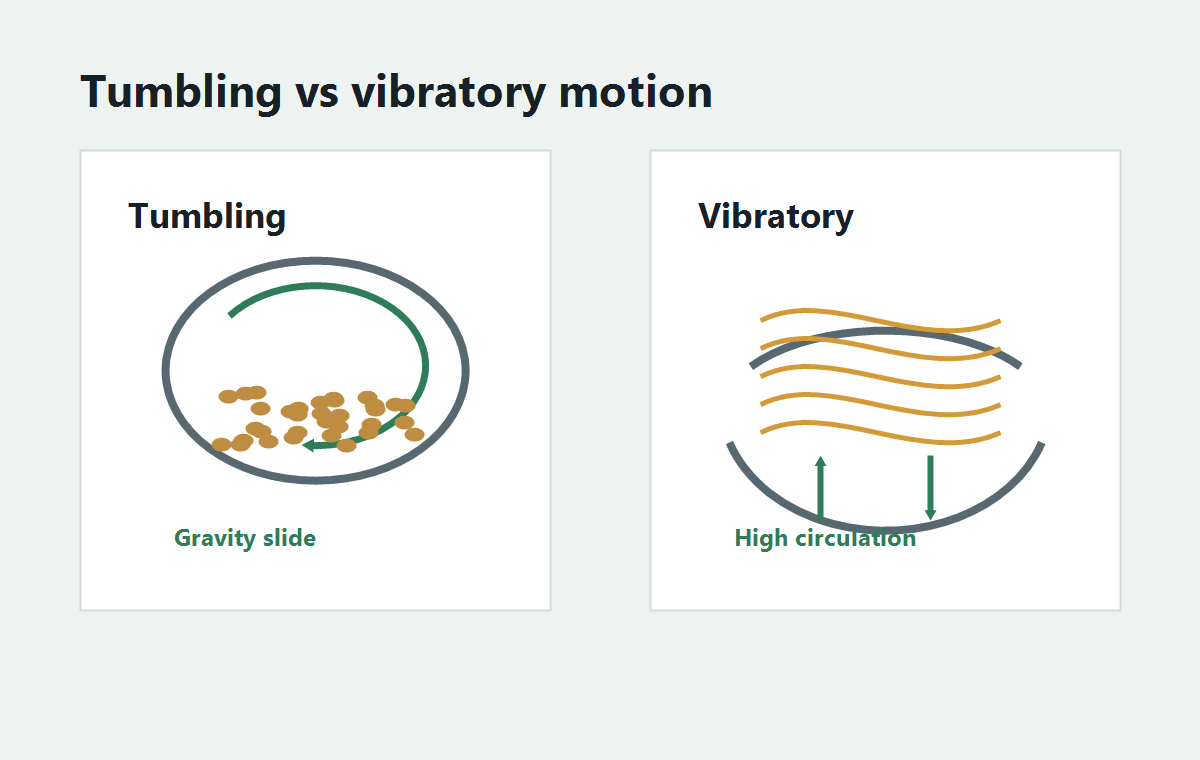
Compared with conventional barrel tumbling, vibratory finishing is usually selected for throughput, automation, easier media separation, and controlled cosmetic surfaces.
Bowl machines can integrate unload gates, screens, conveyors, dryers, and compound delivery for repeatable shift production.
The process is more rubbing and circulating than falling, which can reduce dents on many parts when load ratio and media are correct.
Tub-style machines are often better for long, flat, or larger workpieces that would collide heavily in a rotary barrel.
| Equipment type | Best use | Engineering notes |
|---|---|---|
| Vibratory bowl | Small to medium parts, automated separation, general deburring | Good all-around production machine when parts can flow freely with media. |
| Vibratory tub | Long parts, larger workpieces, delicate components | Often better than a bowl for parts that need more space or less nesting. |
| Continuous flow system | High-volume production lines | Works when cycle time, part geometry, and downstream handling are stable. |
| High-energy vibratory | Faster deburring and stronger smoothing | Requires tighter control of media, compound, and part damage inspection. |
If the job is low-volume and cost-sensitive, start with the Tumbling Machine Guide. If the job needs high throughput, automated separation, or lower impact risk, use the process comparison tool before selecting equipment.